
Passive Index investing, does it work in India, and for which all indexes?
Passing investing works in India, till the investible universe is limited to NIFTY 200; however beyond which it doesn't. NIFTY IT is one sectoral index that one can consider as an alternate to NIFTY50

During the last week, I was discussing with a couple of friends on their investment philosophy, and this question came about, should we just passively invest in the index funds? and if yes, then which all indexes makes sense. While for some of the indexes its obvious (as mentioned below), for other funds it got me thinking somewhat.
For this analysis, the SPIVA India Scorecard was used. For those who don’t know SPIVA India Scorecard compares the performance of actively managed funds against the performance of the non-sector specific indexes (namely, Large Cap, Mid/Small Cap, and ELSS’s performance) and measures how many such active funds were outperformed by the index.
Link for the SPIVA 2022 report can be accessed here: Link.
While there are multiple pages, summary of the report is this:
Almost 90% of the Large Cap funds are outperformed by the Index and thus holding a simple Nifty Index Fund would give out a better sleep, than putting funds in the large cap funds.
ELSS Funds / Funds which are operating in the Mid-cap space don’t fare much better, and the simple index outperforms the “active” funds
So yeah, passive indexing works in IndiaAs we move down the market-caps of the stocks, the Indian Active Fund managers seems to be doing a good job, and only ~50% of the funds have been outperformed by the Index.


Why would that be? Two simple reason as per me:
Holding index funds costs ~0.05 bps vs Active Funds which may charge from 0.5% to 1.75% (assuming 0.5% is given to distributors on an average; MAX Expense Ratio limits)
The Large-caps domain is a well discovered/well tracked domain and therefore finding an edge becomes difficult; where as in the small-mid cap space, there are still companies which are establishing their niches and remain un/under-discovered.
What to do if you want peace of mind as well as market performance:
If you are okay in placing an order through your broker, then buy the Nifty ETFs (NIFTYBEES, SETFNIF50, ICICINIFTY; full list here)
Or if you are more an SIP route person, then simply buy a low cost index fund, e.g. Navi Nifty 50, UTI Nifty Index Fund
If you are the more risk taking side, then buying an index fund tracking the Mid/Small cap index won’t make much sense and one is better off choosing a well-performing mutual fund. (How to identify one? well that’s the topic of another substack)
So till now we have established, that indexing works in India, till you are limiting yourself to the Nifty 50/Nifty 100/Nifty 200. Beyond this it doesn’t works.
What about Sectoral Indexes?
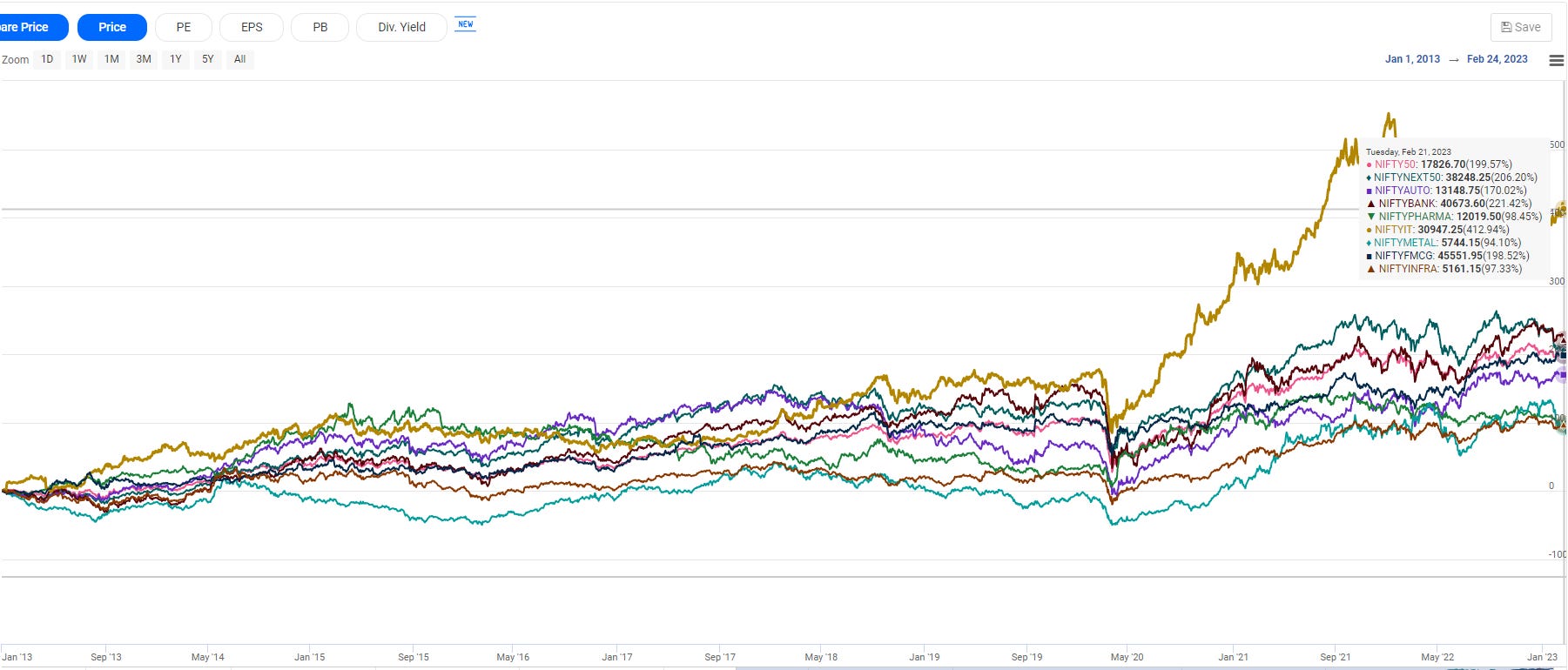
Source: Trendlyne
The above graph represents the return by the various sectoral indices over the last 10 years. If you think that reading the above graph is difficult, I agree, and therefore have captured the 10 Year point to point returns as 10-Year CAGR return of the NIFTY and other indices below:

Well apart from TWO sectors (i.e. IT and Banking), all the sectors have under-performed the NIFTY, though there would always be times where depending on the market cycle, the sectoral funds would have out-performed the NIFTY 50. But taking that kind of exposure leaves you open to market timing risks, where both the entry and exit points become critical to make a good return.
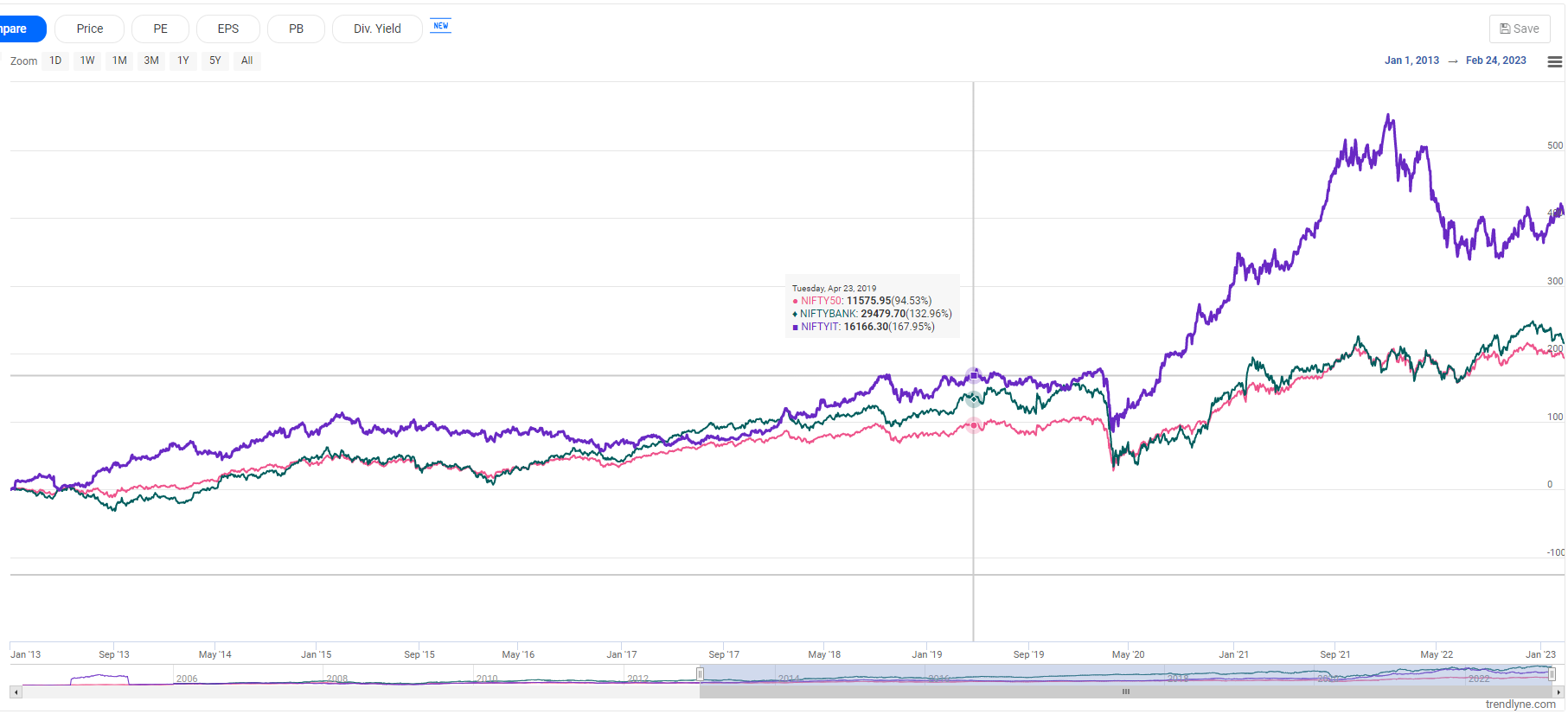
Looking at the Banking and IT sectors vs NIFTY, one can see that while the Banking sector has outpaced NIFTY on an overall basis, there have been periods of under-performance and therefore the Banking sector is also a prisoner to the market timing and cycles. So while the saying that if the economy has to grow (as reflected by growing NIFTY 50), the banking sector will have to grow by more than 1x might be true, but its also true that it might not reflect in the index’s performance.
So what does it leaves us with? NIFTY IT Sector which seems to have always been outperforming the Index, across thick and thin, and therefore if one has to explore an alternate index to NIFTY 50, NITFY IT Index is probably the only index that one can consider.
What about the NIFTY IT Focused Mutual Funds?
Well unlike the performance of the large-cap active funds (refer table at the start) which were not able to beat their NIFTY 50 benchmark, the story in the NIFTY IT sectoral mutual funds is a bit different, with the NIFTY IT focused mutual funds category being able to out-perform the index in 9 out of 10 years (may be coz these funds have been able to invest across market-caps).

So one can look at both the NIFTY IT index as well as the “Active” funds which are tracking the NIFTY IT index, to achieve a superior investments performance. The list of such funds which are tracking the NIFTY IT index is available here.
Takeaways:
Passive Index based investing works till you are limiting your investment horizon to Nifty 200
Beyond the NIFTY 200 universe, active funds out-perform the index, may be due to information arbitrage
Sectoral index funds, have generally lagged the NIFTY’s performance with IT index being the only one to have outpaced the NIFTY
Active sectoral IT funds have outperformed NIFTY IT (and thus also NIFTY) and thus can be considered.